Showing posts with label Asia. Show all posts

Friday, December 30, 2011

Mystery Pyramids Egypt

Giza
Egypt lies between the continents of Asia and Africa, although many people regard as the continent of Africa, because more than 90% of its territory in Africa. Egypt's position is closer view of Asia, and Europe could seem at odds with Strategic. bordering the sea in north central, south by Sudan, west to the east by Libya and the Palestine Red Sea and Israel. Egypt is a very beautiful tourist destination with a variety of destinations for tourists. We all know about the major features such as the pyramids of Egypt. According to archaeologists, the Great Pyramid of Giza is the oldest and largest pyramid of the three pyramids at Giza necropolis, and it is believed that the pyramid was built as a tomb for the fourth dynasty Egyptian pharaoh, Khufu (Χεωψ, Cheops) and constructed for more than 20 years and is estimated take place in the years around 2560 BC. This pyramid is sometimes referred to as the Pyramid of Khufu.

Great Pyramid of Giza is the tallest man-made buildings. This pyramid is not only admired the grandeur from the outside but tourists can also enter into a narrow tunnel with a length of about 30 meters. Pyramid has an estimated 2,500,000 cubic volume, height 146.6 meters and 230.5 meters wide basically. Or the size of the entire 922 meter length basis. There are three tunnels inside the pyramid, the one at the bottom, but not resolved, the other two is a tunnel leading to King Room, and one tunnel leading to the Queen room. To facilitate visitors to enter the tunnel, the floor is made sectional steel beams with wood base. El Giza Giza region or also known as or El Gizeh Gizeh (Al Jizah) is a region located in the area near Cairo (Egypt), the pyramids are found here are the largest category in comparison with the pyramids on earth.

Great Pyramid of Giza is one of the seven wonders of the world today, has always viewed as a mysterious and magnificent building by the people. However, despite how many years have passed, after the experts use a large amount of accurate research tools and sophisticated, is still unknown, who actually has made building a high and majestic giants that? Derived from human intelligence and achievement which can not be imagined on top of the building? And what his purpose to make the building? And at that time he has a usefulness that how or what it means? A puzzle that kept popping up in the minds of all people for thousands of years, from beginning to end is a mystery that can not be explained. Although historians say he was set up in 2000 over BC, but such opinion can not even explain the indecision which are initiated by a large number of discovery research.

During this time, historians assumed that the pyramid is the tomb of the king. Thus, so talk about the pyramid, which is imagined in the minds of jewelry and unnoticed is a glittering goods. And, in the year 820 AD, when the governor-general of Islamic Cairo, the Caliph al-Ma'mun led forces, was first dug a secret passage and into the pyramid, and when it impatiently into the room, a view which looks only made him very disappointed. Not only did no one object that is usually buried with the body, such as pearls, and engravings, even a piece of pottery fragments were not there, only an empty stone box with no lid. While the wall was just a clean empty field, nor was there any text engraving.


EgyptGreat Pyramid of Giza that lies on the stretch of desert temperatures over 35 degrees Celsius, it consists of three large pyramids and the Sphinx fruit. Third is the pyramid of Khufu (Cheops), Khafre (Rakhaef / Chephren) and Menkaure (Mycerinus) plus the three small pyramids. Each of the pyramid of Cheops and Mycerinus Chepren have a common interior. There is a king room, queen room, the door of the tunnel. Most residents in the century known as a farmer. they utilize the Nile valley to serve as their waters. Pyramid has been shaped by the culture of the past. The most famous pyramids are the pyramids in Egypt. It is argued that human beings at that time was not the same as the people of today, the weight was like a giant human being, so it can transport large boulders. There is also the opinion of Egypt at the time of 11,000 BC has a great culture but that culture has vanished. And there is also the opinion of pyramid building was no interference with the alien space creature. But all of the opinion that no one has been able to prove its accuracy. Until now about the pyramids in Egypt is still a mystery.

Thursday, December 29, 2011

Burj Khalifa

Burj Khalifa is one of the locations where filming Mission: Impossible - GHOST PROTOCOL, which starred Tom Cruise. In the film Mission: Impossible - GHOST PROTOCOL, Tom Cruise's role as a spy Ethan Hunt. While we were busy with filming activities are solid, he still managed to write a message of love to his wife and son. Romantic, the message he wrote on the top of the tower Burj Khalifa. Meanwhile, director of the film "Mission: Impossible Ghost Protocol", Brad Bird, praised the beauty of the city of Dubai. According to Brad, showing consideration of building the Burj Dubai and Khalifa is because the area that looks magnificent and luxurious it is not too much exposed by Hollywood filmmakers.

The name Burj Khalifa formerly known as Burj Dubai, or in Arabic means Dubai Tower, now renamed the Burj Khalifa (Caliph Tower). Dubai ruler Sheikh Mohammad bin Rashed al-Maktoum inaugurated the opening of the 828-meter-high building. He changed the name of the building into the Burj Khalifa in honor of the United Arab Emirates President Sheikh Khalifah bin Zayed al-Nahayan. The tower has more than 160 floors. The tower was designed by Skidmore, Owings & Merrill, based in Chicago, United States, which has long been known in the construction of some of the world's tallest building. Burj Khalifa is the tallest tower in the world. Tower Dubai is the most beautiful jewel of the city of Dubai that is equipped business center as a result of Dubai's major works. The height of the tower Burj Khalifa beyond communications tower CN Tower in Toronto, Canada, which only reached 555 meters, or Taipei 101 with a height of 508 meters. construction of the tower Burj Khalifa cost about 1.5 billion dollars in the United States.

Burj Khalifa has a number of luxurious amenities to pamper the occupants. Facilities like luxury hotels, Armani Hotel, in collaboration with leading designers Giorgio Armani, 900 luxury residential apartments spread over floors 19 to 108, meeting room and business, to sports facilities and other fitness facilities upstairs. The exterior of the tower consists of glass and steel that could cover 17 football fields. In fact, the building is equipped with 57 lifts that also provide facilities for tourists to see the sights of Dubai City as far as 80 kilometers, from the floor 124. To reach that height, it only took about two minutes using the fastest elevators in the world who drove 40 kilometers per hour. Burj Dubai also features shopping malls, business, entertainment, and other modern facilities in a number of buildings that surround the tower.

Burj Khalifa is the world's tallest building and this building was included in the category of the highest man-made structure ever made by humans. Burj Caliph solve a number of records ranging from the world's tallest building, the number of floors at most, the furthest and fastest elevators (64 kilometers / h), and the tallest tower view. Burj Khalifa, has a height of 828 meters with 163 floors and is located in the city of Dubai, United Arab Emirates. Development began construction on September 21, 2004 with the exterior of the structure completed on October 1, 2009. The tower was designed by Skidmore, Owings and Merrill, who also designed the Willis Tower (formerly the Sears Tower) in Chicago and One World Trade Center in New York and many other famous tall building with the main contractor is Samsung C & T of South Korea. The tower was the launch on January 4, 2010 with a total project cost of 1.5 Billion Dollars and 20 Billion Dollars for the whole shops and facilities in the building Burj Khalifa.

Dubai
Burj Caliph is an example of collaboration on a global scale, and the tremendous positive energy which can be generated when people from all over the world come together to work towards a common goal. Thousands of professionals and skilled workers from around the world working on this once in a lifetime project. Burj Khalifa was built using the latest technology in wind engineering, structural engineering, structural systems, materials and construction methods. All design considerations to take into account the 12,000 people who will live and work in the tower. With a total built-up area of ​​about 6 million square feet, Burj Khalifa features nearly 2 million square feet of residential space and more than 300,000 square feet of prime office space, other than the area occupied by the Armani Hotel Dubai and Armani Residences. This tower also features modern lifestyle amenities including clubs, health and fitness facilities, a superb restaurant and observation deck. Burj Khalifa is the picture as the new heart of Dubai.

Wednesday, December 28, 2011

The uniqueness of the Dead Sea

unique
One of its uniqueness, the Dead Sea is not fused or not connected with the ocean. He was like a lake, but the water is very salty, it is much more salty than normal seawater. In fact, the water felt thick and oily skin when touched. Dead Sea is a salty lake (not the sea, because it is on the mainland), the term in use because the area of sea that reached its 76 kilometer length, and has a width of 16 Kilometers, so can imagine if the lake is so vast. The lake is called the Dead Sea because there is no single form of life that can survive in salt water which yield 32%, compared with the Mediterranean sea which is only 3% saline.

Dead Sea in Jordan Rift valley. Geologically, the Dead Sea formed three million years ago when small cracks occur in Jordan Riff, so that sea water into and trapped in it. Because dry air makes the level of mineral concentration in the trapped water becomes high, and forming lakes with highest salt content. If we swim in this lake, we will be floating. Salinity in the ocean is so big it makes us able to float on it without much difficulty swimming, even while reading the book though. Strange indeed, but that's natural events. It is said that dead sea salt in it reaches 32% (that means 9 times that of normal marine salinity of about 3.5%). Due to its salinity levels are then all objects can float on top.

To float away, just back and relaxes the body. The more the body relaxes as if weightless, floating sensation is also increasingly felt our bodies. Much like hollow items above sea level, swinging back and forth the little waves rolling toward shore. Emptying the mind while drifting further adds to the sensation of pleasure of the Dead Sea is far from the hustle and bustle of everyday life. No fish live there, and die when exposed to sea water will be very sore eyes. Behind it all muddy sea has its own benefits for women in particular, as a skin (Sea Mud Body Scrub). In addition to the salt content is extremely high, Dead Sea water also contains potassium, magnesium, and bromine. Maybe that's why the Dead Sea mud is considered to be very efficacious. The main objective of tourists visiting the Dead Sea lake, but because of its history, mainly because he wanted to lubricate the body with mud from the lake is rich in salts and minerals essential for skin health and beauty.

SeaDead sea salt can also act as a disinfectant that can remove harmful substances from the skin. Not only water, salt and mud that contains mineral wealth, even the air in the area around the Dead Sea also contain minerals because that area is the lowest area on earth, then there is the evaporation of sea water in large quantities. Sea is located at 420 meters below sea level, which is the lowest area on the surface of the Earth (while the deepest point on the earth itself in holding the Mariana trench.) Dead Sea area is between Jordan and Israel. Dead Sea location closest to the city of Jerusalem can be achieved through the easiest area of white rocky hills of Qumran. Name of Qumran is famous as the place of discovery of the letters roll history that is stored in the Dead Sea jug-jug made of clay.

Tuesday, December 27, 2011

Underground Tunnels

Vietnam
The Vietnam War is long gone. However, the remnants of war can still be found in Ho Chi Minh City (HCMC). In fact, the rest of the war was packaged into attractive tour packages to not miss when visiting HCMC. Talk-20th century history, we certainly can not miss the Vietnam War (1955-1975). This war involving North Vietnam, backed communist ally, and South Vietnam, backed by the United States and other anticommunist nations. The war ended 30 April 1975 when Saigon finally fell into the hands of North Vietnam.

The Vietnam War is one of the most important moments in world history. Apart from the war claimed millions of lives and material losses are infinite. And in that war the United States suffered defeat. One cause of the defeat of the United States is due to guerrilla tactics employed by the North Vietnamese troops, or better known as the Vietcong. Guerrilla tactics in the forests of Vietnam makes it difficult for U.S. forces find Vietcong hideouts. The most successful of these tactics is building a network of underground tunnels that exist across the country.

One of the underground tunnels of the famous relics of the Vietnam War is the Cu Chi Tunnels. Currently the Cu Chi Tunnels, on the outskirts of Ho Chi Minh City is a tourist destination of history is very interesting for tourists. Cu Chi Tunnels is a witness to the history of how the Vietcong guerrillas defeat the United States. Through the tunnels of Cu Chi is the Viet Cong guerrillas attacked and managed to hide all of a sudden. Cu Chi was an underground tunnel that has a large network of tunnels to connect the other underground. The tunnel is located in Cu Chi district, within 70 kilometers from Ho Chi Minh City (Saigon). In the area of Cu Chi Tunnels are also monuments, restaurants and mini-hotels that can be visited.

Along the underground tunnels that the Vietcong fighters built its own tensions for the visitors. When entering into the Cu Chi Tunnels, There are just realized that he was suffering from claustrophobia syndrome (problematic in small spaces and narrow), some are resigned to seeing their clothes soiled with clay. Tunnel network that only has about about 70 centimeters, and width of about 50 centimeters. It just still makes visitors feel crowded and did not move freely. Cu Chi Tunnels which can be passed only the tourists, just as deep as about 6 feet, and is the first level. Cu Chi tunnel network has three levels. Levels two and three increasingly narrow and deep.

Can imagine how miserable the lives of ordinary Vietnamese at the time. Formerly an underground tunnel in addition to functioning as a hiding place, also serves as a residence, kitchens, hospitals, headquarters, and so on. The Vietcong hid in underground tunnels during the day, and they only come out at night, when they search for food, care of the farm, or for war. In the distance was heard a voice like a straight shot. Indeed, to further make it more exciting tourist sites, the Cu Chi tunnel complex manager has always sounded like a gunshot sound of firecrackers so that more tourists appreciate the atmosphere. If you want to try to shoot, there are shooting ranges are provided for visitors, of course with an additional fee.

TunnelsIn Cu Chi tunnel complex, but can explore the tunnels, you can also see various armaments, ranging from traditional weapons to the Vietcong used modern weapons confiscated from American soldiers. Several tanks of war booty on display. Before the tour ends, you will be invited to enjoy a short film that tells about the Vietnam War. To complete the tour of the history of Vietnam in Ho Chi Minh City, you can visit the War Remnants Museum or the Museum of Time War which is located near downtown. Underground tunnels that once feared the United States Army, has now become one of the main attractions for tourists visiting the Ho Chi Minh City, who is familiar with the name Saigon. Until now the network of underground tunnels of Cu Chi is still popularly known as Saigon. In 1979, the Vietnamese government declared the Cu Chi tunnel network has become a historic site, and now the interesting sights for tourists.

The Most Beautiful Temple

Temple
Cambodia is an exotic country that borders with Thailand and Vietnam. Cambodia since a few years became one of the world tourist destination. Angkor Wat became one of the main attraction for visitors who come to Cambodia. Angkor Wat is one of the most important archaeological sites in Southeast Asia. Angkor Wat is located approximately 6 kilometers from the town of Siem Reap, access to the area is very easy. Supporting facilities such as accommodation and transportation in place is adequate. Every day thousands of tourists come to this place to witness the beautiful sunrise at Angkor Wat temple. Angkor Wat complex is very large and surrounded by man-made lake called barays.

Angkor Wat is actually just one part of the temples located in the complex of Angkor. However, Angkor Wat is one of the most beautiful temples, and has the most intricate designs in the Angkor complex. Complex of Angkor Wat was built by King Suryavarman II, in the mid-12th century, dedicated to Lord Vishnu, and serve as a royal temple, and the city center. At first Angkor Wat temple serves as a Hindu, but in the 13th century converted into Buddhist temples. This is because in the course of history, with the inclusion of Buddhism in Cambodia is growing more rapidly, then the Temple of Angkor Wat then be used as a Buddhist Temple. This makes the temple of Angkor Wat Temple which became a well maintained, unlike other temples in the Angkor complex.

Angkor Wat complex development process takes about 30 years. As the concept of building a Hindu temple in general, the concept of god-king is shown by the structure of the Meru-shaped building. There are five high-rise towers of Angkor Wat in the middle building. In addition to architectural grandeur, several intact statues with condition no longer to be found therein. Angkor Wat if the note is physically have the same structure as Prambanan in Indonesia. Especially if you see the stone reliefs contained in the outer wall. There is the story of Ramayana, Tirta Amrita or battles with Champa Khmer troops. This is not surprising, because in ancient times the place was once controlled by one of the kingdoms of Indonesia (Majapahit kingdom of Java).
Apart from Angkor Wat, the temple must go in this complex of Angkor Thom (the Bayon) and Ta Phrom

Angkor Thom (Bayon Temple)

Angkor Thom is one part of the archaeological site of Angkor Wat temples. This temple is located about 3 kilometers from Angkor Wat and is unique in building the tower that has carved a smiley face. Most states face was a representation of the face of the king Suryavarman II, the founder. But there is also argued that the faces are the faces of Buddha. The face is engraved on the towers facing the four directions of the compass. Building on the Bayon temple reliefs sculpture consists of 54 faces of Kannon, the Buddhist deity.

Ta Phrom
Ta Phrom

The name of this temple, the memory immediately drawn to the beautiful Angelina Jolie. The temple is located in the middle of this forest was the site of filming Tomb Raider. Characteristic of the building at this place is a giant tree roots that dangle and twist these ancient buildings. Some of the pillars of the temple were given iron to withstand the pressure from the roots. In the beginning Ta Phrom is the location of the residence of the monks amid lush forest with trees. But over time the trees were growing out of control and spread to the building with its roots. Government and foreign donors can only assist with setting up an iron pillar under the building because if done logging, it is feared even make the building collapse. Relief at Ta Phrom is quite a lot with motifs of gods crowned.

Today Angkor Wat Complex became a place of worship for Hindus and Buddhists. If interested in coming to Cambodia, should note that tourists generally come in high season, the month of October to March. In this season, the weather Cambodia was warmer and drier. Most tourists who come from Korea, Taiwan, Japan, Vietnam, Thailand, as well as Europe and America who co-direct flight from Singapore or Bangkok.

Sunday, December 25, 2011

World Heritage

Sangiran is an important site for the development of various fields of science, especially for research in the field of anthropology, archeology, biology, paleoanthropology, geology, and of course to the field of tourism. The existence of Sangiran site is very useful for studying prehistoric human life because the site is equipped with ancient human fossils, the results of early human culture, flora and fauna, ancient fossils and their stratigraphic picture. Sangiran bypassed by the river is very beautiful, namely Cemoro river, which empties into the Solo River. This area is experiencing soil erosion so that the layer of soil that forms seem clearly different between soil layers with each layer of soil to another. In the layers of this soil, which until now are found the fossils of ancient humans and animals.


Ancient Humans Sangiran site began in the 1930s when a German anthropologist named Gustav Heinrich Ralph von Koenigswald found a hominid fossils at Sangiran. The discovery of fossils in the excavations and the study reinforces the theory of human evolution from ape to human to human as it is today. At least five types of fossils of early humans are different. This discovery is very surprising and became a key element in the development of the theory of human evolution. Sangiran a site that contributed nearly 50% of the discovery of prehistoric human fossils in the world.

Not only humans and prehistoric life, also found fossils of sea creatures below, giving rise to the theory that the island of Java lifted from the seabed millions of years ago. Even in the 1980s, scientists at the appalling with the discovery of intact fossil of a mammoth with a height of 4 meters. These fossils are now stored at the Museum of Geology of Bandung. Because the contribution to the world of archeology, anthropology, geology and science are so great, Sangiran UNESCO World Cultural Heritage to 593 on December 5, 1996 in Merida, Mexico. Then Man Archeological Museum was built to store and display the fossils were found.

In museums and sites can be obtained Sangiran detailed information on patterns of early human life in Java, which accounts for the development of science such as Anthropology, Archaeology, Geology, Paleoanthropologi. In this Sangiran site also, for the first time discovered the lower jaw Pithecantropus erectus fossils (one of the species in the taxon Homo erectus) by the German archaeologist, Professor Von Koenigswald. More interestingly, in the area of Sangiran site also traces of the remains were 2 million years to 200,000 years old can still be found until now. Relatively intact as well. So experts can assemble a common thread of a history that has ever happened in Sangiran sequence. Sangiran, has been defined by UNESCO as a World Heritage Site. On this site discovered thousands of fossils which accounts for nearly half of all ancient human fossils in the world. To Sangiran, you seemed to be brought back in time thousands of years ago.

Sangiran Museum Collection

Here are some collections that are stored in the Museum Sangiran: (1) Human fossils, such as Australopithecus africanus (replica), Pithecanthropus mojokertensis (Pithecanthropus robustus) (replica), Homo soloensis (replica), Homo Neanderthals of Europe (replica), Homo Neanderthal Asia (replica), and Homo sapiens. (2) Vertebrate fossils, among other namadicus Elephas (elephant), Stegodon trigonocephalus (elephant), Mastodon sp (elephant), palaeokarabau Bubalus (buffalo), Felis palaeojavanica (tiger), Sus sp (pig), sondaicus Rhinoceros (Rhino), Bovidae (cow, bull), and Cervus sp (deer and sheep). (3) Fossils of marine and freshwater animals, among others Crocodillus sp (crocodile), fish and crabs, shark teeth, sp Hippopotamus (hippopotamus), Mollusca (class Pelecypoda and Gastropoda), sp Chelonia (turtles), and foraminifera. (4) Rocks, including chert, Chalcedon, meteorites, and diatoms. (5) Stone artefacts, including flakes and blades, shaved and auger, rectangular axes, stone balls and ax perimbas.

Sangiran site is in the Sangiran Dome region, which is part of the depression Solo, at the foot of Mount Lawu (17 kilometers from the city of Solo). Sangiran Museum and archaeological sites, in addition to being an interesting tourist attraction is also the arena of pre-history research on the life of the most important and comprehensive in Asia, even the world.

Friday, December 23, 2011

Indonesia Rich World Cultural Heritage

Geologically, the territory of modern Indonesia appeared roughly around the time of the Pleistocene when still connected to the Asian mainland. The region's first settlers was a man known to Java at that time about 500,000 years ago. Indonesian archipelago such as the current is formed when the melting of ice after the end of the Ice Age. Indian scholars have written about Dwipantara or Dwipa Javanese Hindu kingdom in Java and Sumatra around 200 BC. Kingdom of West Java Tarumanagara master about the year 400. In the 425 years of Buddhism had reached the area. It is therefore not surprising that Indonesia is rich in places where relics of the past. Therefore, many places in Indonesia are considered a world cultural heritage. There are at least seven places in Indonesia that are considered as a Unesco world heritage.

1. Ancient Human Sangiran Site

Excavations conducted here from 1936 until 1941 had found the first hominid fossil at this place. After that, had discovered 50 fossil paleo Meganthropus and Pithecanthropus erectus / Homo erectus - half the number of hominid fossils that are known around the world. Occupied for one and a half million years, Sangiran is one of the key sites for understanding human evolution. Ancient Humans Sangiran site became a World Heritage Site since 1996. In this place, we can find a lot of information about the remains of past life. In addition, there is complete information about the history of early human life with all the things around him. From about a place to live, life patterns, animals that live with him until the occurrence of the landscape within a period of not less than 2 million years ago.

2. Borobudur Temple area

Borobudur was built during the reign of dynastic dynasty in the 8th century. Borobudur temple is located in Magelang, Central Java. This temple was built in three rows of tiered: a pyramidal base with five concentric square plot, axis cone with three circular platforms, and a large stupa at the top. The walls and staircase railing decorated with fine low reliefs, covering the area of the surface area of 2500 square meters. Around the circular platforms are 72 stupas with patterns of holes, each containing a statue of Buddha. This monument was repaired with assistance from UNESCO in 1970. Borobudur Temple area became a World Heritage Site since 1991.

3. Prambanan Temple

Prambanan Temple is located 17 kilometers from the city of Yogyakarta. Built in the 10th century during the reign of two kings, namely Rakai Pikatan and Rakai Balitung. This place is the biggest temple in Indonesia area dedicated to Lord Shiva. Stand on the center of the concentric square are three temples decorated with reliefs of the Ramayana story illustrations. Prambanan temple is dedicated to the three major Hindu deities (Shiva, Vishnu, and Brahma) and three temples dedicated to the animals who serve them. Prambanan Temple a World Heritage Site since 1991.

4. Komodo National Park


This volcanic island inhabited by a population of about 5,700 giant lizards, the appearance and aggressive behavior makes them called 'Komodo dragons'. Komodo dragon populations can not be found elsewhere in the world and become the object of research of interest to scientists in studying the theory of evolution. Rocky hillside in the dry savanna and a small area where the growth of green plants is in stark contrast to the prickly beautiful white sandy beaches and blue waters surging behind the reef. Komodo National Park a World Heritage Site since 1996.


5. Ujung Kulon National Park

National park located at the far southwestern tip of Java and the Sunda islands on top shelf includes Ujung Kulon peninsula and several offshore islands, including nature reserves covering Krakatoa. In addition to natural beauty and interesting geological attraction, especially for the study of volcanoes on the island, this national park has a remaining area of lowland rainforest of the largest in plain Java. Several species of rare plants and animals can be found there and the Javan rhinoceros is the species most seriously endangered. Ujung Kulon National Park a World Heritage Site since 1991.

6. Lorentz National Park

Lorentz National Park (2.5 million hectares) is the largest conservation area in Southeast Asia. This park is the only conservation area in the world that includes a broad landscape, ranging from snow-capped mountains to tropical marine environment, including low-lying wetland area. The area is situated at the meeting point between the two continental plates collide, has a complex geological characteristics with the formation of the mountain is still ongoing and the expansion of the mainland due to the process of glaciation. Lorentz National Park also has fossil sites that provide evidence about the evolution of life in Papua New Guinea, a high level of endemism, as well as the highest biodiversity in the region. Lorentz National Park a World Heritage Site since 1999.

7. Tropical Rain Forest, Heritage of Sumatra Island

Tropical Rain Forest is an area of 2.5 million hectares of Rainforest Heritage of Sumatra which consists of three national parks: Gunung Leuser National Park, Kerinci Seblat National Park, and the South Bukit Barisan National Park. The area has tremendous potential for long-term conservation of the biota of Sumatra distinctive and diverse, including many endangered species. The area is protected habitat for an estimated 10,000 species of plants, including 17 endemic genera; more than 200 species of mammals and about 580 species of birds that 465 of them inhabit this area and 21 which are endemic. Of the mammal species, 22 are from Asia and not found elsewhere in these islands and 15 of them exist only in the territory of Indonesia, including the Sumatran orangutan is endemic. This area also provides biogeographic evidence of the evolution process of the island of Sumatra. Tropical Rain Forest, Heritage of Sumatra island became a World Heritage Site since 2004.

Thursday, December 22, 2011

Tourism in Toraja grave

Toraja is one of Indonesia tourist attraction, inhabited by a tribe that inhabited the mountains of Toraja, and maintain a lifestyle, and still show the original Austronesian lifestyle, and culture is similar to Nias. This area is one tourist attraction in South Sulawesi is very interesting, and you should not miss. Toraja is famous for its culture, one of which is a unique place of burial, as well as extreme as, grave Cave Londa, Lemo Stone Tombs, Grave Stone oldest in the village of Kete 'Ke'su, and Baby Grave Kambira.

1. Londa cave tombs

Londa is one attraction that must be visited by the tourists. Inside the cave there are hundreds of skulls, and thousands of bones, which some hundreds of years old. There are also coffins are still new. However, the air inside the cave was cool and odorless. Londa Cave, is the cemetery on the cliffs, one side of the grave was in the height of the hill, has a deep cavern, where bodies crates in the set, and are grouped based on family lines. On the other hand, from dozens of tau-tau (the statues) are hidmat standing on the balcony like a living face, open eyes gaze with wibawah. Londa is a natural cave that serves as a cemetery. Londa has two caves that can be entered by visitors. Two caves are interconnected, but visitors should be half crawling. The length of this cave is about 1000 meters. Londa Cave has the story of Romeo-Juliet romantic version of Toraja.

2. Grave stone lemo

This place is often referred to as the home of spirits. At the funeral Lemo you can see the dead bodies are stored in the open air, amid the steep rocks. This cemetery is a blend of death, art and ritual. Lemo is a rocky wall tombs, and statues (tau-tau). Number of holes there are 75 pieces of ancient stone, and tau-tau standing some 40 pieces, as symbols of prestige, status, role and position of the nobility in the village Lemo. Lemo named because the stone canal model is there that resembles a round orange and speckled. Here the bodies are placed in holes in a rock cliff wall. People used to emboss this cliff over the years, so that the bodies of the deceased can be planted in it. The higher the location of his casket, meaning also the higher social strata. In Tana Toraja Lemo Stone Tombs can be seen porch tau-tau on the steep rock walls, overlooking the open kealam. Tau-tau Grave Stone Lemo, or small wooden statues that are considered human beings embody the spirit of the dead are made of wood, or bamboo. Periodically clothes can be replaced through a ceremony called Ma'nene (salute to parents).

3. The oldest grave stone in the village of Kete' Ke'su


Before, people familiar with the more advanced cultures, the Toraja caskets put the corpse in the cliffs without the plant. Visible bones strewn around the cliffs and crates that are fragile, and hollow. These crates are thousands of years old. This cemetery is older when compared to the graves at Londa and Lemo. At Kete Kesu complex, visitors can also visit the tomb stone, which is located about 50 meters behind tongkonan. The journey continues by climbing a small hill, which is about 10 meters. On the left side of the street terraces, there is the rock, which is filled with holes. In the pits there are human bones and skulls. Bury the stone in Kete 'Ke'su including the oldest in Tator. Age tomb stone was estimated at more than 700 years. When we stepped into a higher place in the rock, can be seen the statues of wood as a picture of those who had been buried there. There are dozens of statues that are placed inside a small gap further inside, with iron-barred door. Tomb stone is quite complicated and expensive manufacture. to make a stone tomb measuring two meters wide, two meters high and two meters deep, it took about 300 days.

4. Baby grave kambira

A special cemetery for babies (baby Graves) in the tarra trees. It appears the black square boxes in the main stem of trees poking. Boxes, is already perforated, and filled with dead baby. The bodies of babies who have not grown teeth buried in the tree Tarra (no longer done since the last decades), but the tree where save the baby's body was still upright, and many visited by tourists. Tree that has fruit like breadfruit, with a circle of tree trunks about 1 to 3.5 meters, saved dozens of dead babies. The body is inserted into the trunks of trees, which advance the tree trunk hollowed out, then covered with palm fiber. Tana Toraja society still considers the place sacred, like a newborn child. Placement of the baby's body in this tree, according to the social strata of society. The higher the degree of social family the higher the baby who was buried in the trunk Tarra. Infants who died, laid in the direction of the bereaved family residences. This cemetery is only done by the Toraja people, followers Aluk Todolo (belief in ancestors). Implementation in a simple ceremony. And just like that baby who was buried without the wrapper, like a baby still in the womb. After decades, the baby's body will blend with the trees.

How interested to visit the tomb in the Toraja?. In addition to a place famous for the tomb of a unique and extreme, Toraja also famous for its tourist attractions and other indigenous traditions, such as Makale Rantepao, Tongkonan Traditional House, Desa Adat Pallawa, Ceremony, Adu Buffalo, Sarungalo Tomb, Carved Wood Tana Toraja, Cain typical Tana Toraja, and others.

Exotic Islands Raja Ampat

“ Raja Ampat lies hidden in a remote corner of the sea, surrounded by the world’s most-complicated island geography. It’s a coral universe with enormous currents and tides bathing the reefs in an endless plankton stew. The combination of an infinite range of habitat and rich currents has produced an undersea wilderness dripping in biodiversity. A true Last Place on Earth “ - David Doubilet and Jen Hayes

Raja Ampat in West Papua's remote location. This area stores a million beauty beneath the sea. Raja Ampat marine tourism is known as one of the 10 best dive tours in the world. Raja Ampat is the most visited tourist destination because of its underwater beauty of the scenery. Most tourists who come to Raja Ampat has a goal to dive. Charm and richness of the underwater world, a mainstay of the Raja Ampat regency through competitive world of tourism in Indonesia and the world. This area is known as a center for tropical natural resources of the world's richest.

Raja Ampat region has more than 1.070 species of fish species, 600 species of coral reef species and 699 types of molusca. Compare this with the entire Caribbean region that only has no more than 70 types of coral reefs. No place on earth that has so much diversity of marine life as much as Raja Ampat. This could be due to the population are very few who still use traditional fishing equipment and limited access between islands that actually protect it from damage natural ecosystems.

Biodiversity and marine life of Raja Ampat's most rich and diverse from all areas of marine parks in the area of the world's coral triangle, Filipinos - Indonesia - Papua Nuigini. Coral Triangle is the heart of the wealth of the world's coral reefs are protected and defined by the International nature conservation protection. Raja Ampat region also stores the history of the relics of war machines, ships and aircraft, a former World War II. Wai near the island you will find a wreckage of the plane P 40's old ally. The aircraft was lying at a depth of 27 meters and found relatively intact since 1999.

There are several areas of coral reefs are still very good condition with the percentage of live coral cover by 90%, namely in the Dampier Strait (the strait between P. and P. Waigeo Batanta), Kofiau Islands, Islands and South East Misool Wayag Islands. Types of coral reefs in Raja Ampat is generally fringing reef with gentle slope to steep contour. But it also found the type of atoll and the type of scorched or taka. In some places like the village Saondarek, when the lowest tides, coral reefs can be seen without a dive and with his own adaptation, these reefs can still be alive despite being in the open air and direct sunlight.

Unique species that can be found at the diving is some kind of dwarf seahorses, wobbegong, manta and stingrays. There are also endemic fish Raja Ampat, namely Eviota king, which is a kind of fish gobbie. At Manta Point supernal Arborek Dampier straits, you can dive in the company of some tail Manta Ray is benign like when you dive in Derawan Islands, East Kalimantan. If you dive at Cape Kri or Chicken Reef, you can be surrounded by thousands of fish. Sometimes a collection of tuna, giant trevallies and snappers.

Raja Ampat Islands located in the northwest of New Guinea bird's head, with about 1500 small islands and atoll as well as 4 large main island, namely Misol, Salawati, Bantata and Waigeo. The area is approximately 4 million square hectares of land and sea - including some Paradise bay - making it the largest marine park in Indonesia.Sekalipun most tourists who come to the Raja Ampat Islands are the diver's current, actual location is attractive also for tourists in addition to divers because also have white sandy beaches are very beautiful, island chain-nan stunning karst islands and unique endemic flora and fauna such as red paradise, paradise Wilson, maleo Waigeo, various parrots and parrot, couscous Waigeo, as well as various types of orchids.

Wednesday, December 21, 2011

City ​​of Batik

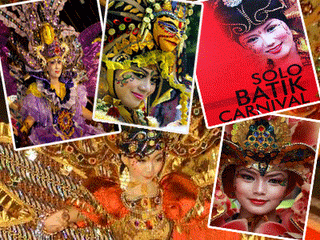
Currently, the batik industry began to grow and rise again. Batik began squirming everywhere. Solo as one of the city that gave birth to the tradition of batik, known as Solo Batik. In the course of cultural, Solo Batik has become one of the root growth of the batik tradition of the archipelago. The local government of  Solo (Surakarta) has great attention to the existence of Batik. Batik as one of the cultural assets should continue to be preserved. To accelerate growth and image of the City of Batik, Solo entered into the program, Solo Batik Carnival (SBC). Inaugural event was held in April 2008, which later became a routine agenda which is held every year. Solo Batik Carnival held around June. Solo Batik Carnival is a festival designed Surakarta city government, to lift the image of the city of Solo as batik. Carnival show is also to preserve the richness of batik as one of the most culturally identical in Solo.

Solo Batik Carnival is a carnival (batik demonstration outdoor) community-based using batik, local genius city of Solo, as a source of basic ideas and creativity of community spirit, which is in harmony with the city of Solo. Solo the Spirit of Java (Solo is the soul of Java). Hope this carnival will be closer to the indigenous community Solo loves his city and town growth in an increasingly pluralistic and multicultural. Carnival takes the route from Solo Center Point (Purwosari, (Slamet Riyadi road) and ends at City Hall Government of Surakarta (road Sudirman ). Carnival activities "Solo Batik Carnival" is able to attract tens of thousands of visitors who thronged along the road Slamet Riyadi Solo.

Srawung Batik, is a companion event Solo Batik Carnival. An exhibition of batik and handicraft product range, followed by SMEs batik and handicrafts from the city of Solo. Batik Srawung aims to glue the relationship batik crafters, artisans, small businesses and SME handicraft batik batik with the consumer, empowering people's economy and established that Solo City as the City of Batik. Approximately 500 participants from various walks of Solo (Students / High School / professional organizations, cultural organizations, private organizations and state enterprises, government and private institutions, arts groups, individuals and so on).

By using batik as the main ingredient, participants will make carnival costumes in accordance with a specified theme. Hundreds of batik fashion models will demonstrate the results of independent creations with the look and design attractive, compelling, and courageous. Solo Batik Carnival is now held at night or different from the previous year, taking the theme of characters who are well known legend of the Java community, such as the Queen of the South Coast, Roro Jonggrang, Ratu Kencana Wungu, Ande-Ande Lumut and others. Solo Batik Carnival took the route along Jalan Slamet Riyadi. With a distance of about four kilometer, starting at around 07:00 pm tonight until around 10:00 pm tonight. Carnival begins with army soldiers Surakarta palace, and then followed by a traditional Javanese dress patterned batik spread in the days of empire. Then group your son or daughter is wearing character stories Javanese legend. Solo Batik Carnival international who have a class that looks glamorous, but not abandon its traditional.

Indonesia should thank the city of Solo, because the Solo city, now batik recognized by the world. On October 2, 2009, UNESCO set batik Indonesia as one of World Cultural Heritage. No false, if the Solo is called Batik city.  Because Solo is producer batik the largest in Indonesia, even in the world. Some of the famous batik business in Solo is Batik Keris, Batik Danar Hadi and Batik Semar. Meanwhile, the commercial center of batik in Solo city  is located at Pasar Klewer, Solo Wholesale Center (PGS), Beteng Trade Center (BTC), the area and Kampung (village) Batik Batik Laweyan and Kauman.

The Best Tourist Destination In Istanbul

Economic activity, industry, tourism, entertainment and education is growing rapidly in this city. Trips to Istanbul is like a trip into the past with modern civilization. A variety of relics of the royal buildings Byzantine, Roman and Ottoman will be maintained, side by side with modern buildings continue growing rapidly. Istanbul is a city cultural meeting place for east and west, the city which is part of two continents, Asia and Europe. Istanbul is a city of "two continents". Istanbul keep a very diverse culture, the modern culture of western mixed with the traditional culture of the east. The buildings and objects of art is a mixture of original culture of Turkey, Byzantine and Roman.

One of the popular tourist spot for tourists because of its uniqueness is the Museum of Hagia Sophia or Aya Sofia. Hagia Sophia (Greek: Άγια Σοφία, "Holy Wisdom"), Sancta Sophia in Latin or Aya Sofya in Turkish, is a former church building (basilica) and the mosque, now a museum in Istanbul. Because it has two functions, namely as mosques and churches, in this museum can be found two symbols for Christians and Muslims. Museum of Hagia Sophia or Aya Sofia, before becoming a museum was once a mosque. And before it became a mosque, this building is the church called Haghia Sopia. Age of the building is about five centuries. This building is the pride of the Muslim community in Istanbul, Turkey. The beauty of the architecture is so amazing. Visible from the outside, there is a dome with a size so big and tall. Diameter in the middle of 30 meters, and height 54 meters. When entering the building, visible beauty of the interior is decorated with mosaics and frescoes. Poles are made of colored marble. While the walls are decorated with various carvings. Besides the beauty of the interior, the appeal of this building was also obtained from the historical value. This is where the symbol of the struggle between Islam and non-Muslims, including secular values after the collapse of the Ottoman Caliphate.

Period Byzantine Empire
Until 1453, the Hagia Sophia cathedral is the church (basilica) Byzantines built by Constantius, the son of Constantine the Great. The church is often damaged by the quake. On 7 May 558, at the time of Emperor Justinian, the eastern dome, collapsed affected by the earthquake. On October 26 986, in the reign of Emperor Basil II (958-1025), the building was again hit by the quake. Finally, a major renovation at the beginning of the 14th century made, so that these buildings are not destroyed by the earthquake. The specialty of this building is situated on a large dome shape and height. The size of the center is 30 meters. High and fundamental is 54 meters. The interior is decorated with mosaics and frescoes, its pillars are made of multicolored marble, and walls adorned with carvings. The building of this church also looks solid, handsome, and charming in the city of Istambul.


Ottoman Turkish Period
When Sultan Mehmed II conquered Constantinople on Tuesday, May 27, 1453 and entered the city, Mehmed II dismounted and prostrated thanks to God, then go to the Church of Hagia Sophia and ordered to change into a mosque known as the Aya Sofia. Jum'atnya directly converted into mosques for Friday prayers. Various modifications to the building to be done to fit the pattern and style of mosque building. At the time of Mehmed II (1444-1446 and 1451-1481) built four towers in the south. Selim II (1566-1574) to build two towers and convert part of the building is characterized by the church. Including changing the sign of the cross on display at the top of the dome with a crescent moon ornament. As a result of cultural contacts between the Turkish people are Muslim with the Christian culture of Europe. And finally the original architecture of the mosque has a flat roof and the dome shape, then began to recognize the pointed roofs. After identifying a tapered roof form is the starting point of development of mosque building is magnificent, mighty impressive and vertical. This also led to the emergence of a new style in the appearance of the mosque, which is developing the arches at the entrances, to gain a broader impression of space and height.

Museum
In 1937, Mustafa Kemal Atatürk changed the status of Hagia Sophia into a museum. Begin the project "The demolition of Hagia Sophia". Some parts of the walls and ceilings scraped off the paint-paint calligraphy until rediscovered paintings of Christian sacred. Since functioned as a museum, visitors can see the Christian and Islamic cultures mingled adorn the walls and pillars in the building Aya Sofia. The section of the ceiling on the second floor are painted calligraphy exfoliated to form mosaic paintings of sacred Christian relics of the Church of Hagia Sophia back into view. While the Aya Sofia Mosque relics that adorn the walls and pillars in the other room will be retained. Since then, the Aya Sofia mosque as one of the famous tourist attraction in Istanbul by the Turkish government. Historical value covered with beautiful Byzantine-style architecture fascinating.
At present, be building it as The Best Tourist Destination In Istanbul, Turkish. If you chance to visit there, you really will feel the religion is often dragged into here and there to suit the interests of power. Church of Hagia Sophia, Aya Sofia Mosque, Hagia Sophia Museum, or by whatever name we should call it, is a symbol of politics that is not wise; politically justify any course (including the use of religion) for the sake of political interests.

Tuesday, December 20, 2011

The Batik Museum

museum
Since centuries ago in the land of Java, batik is an expression rooted in mythology, philosophy, and the symbols surrounding the life cycle. From China and India come the influence of Hinduism and Buddhism, while the Arabs and Persians came from Islamic nuances. The trail is reflected in a variety of shades of batik on the north coast of Java island and in the center of the aristocracy of Surakarta and Yogyakarta. Batik is an art masterpiece-laden craft influenced the course of time and environmental changes.

As the fruit of interaction with the times and historical circumstances, batik is distinguished by the pattern, style, and color. Batik Palace, which combines Hindu culture to infiltrate the Palace of Java in the fifth century (through ornament eagle, dragon, lotus, and the tree of life), and with Islamic culture that came after (the hallmark of a variety of stylized symbols). Batik Palace, includes range of batik from Kasunanan Surakarta, Yogyakarta Sultanate, Pakualaman small palace, and Mangkunegaran. Dutch batik erupted in 1840 and reached a peak in 1890-1910, the pilot of the Dutch / European in the area north coast of Java. The color and variety of motives that bring distinctive style unique and significant individual. Chinese Batik that came later, rich with oriental ornaments (snake, lion, dragon, and bird Phonix) in bright colors and pastels from production centers in Pekalongan, Cirebon, Kudus and Demak. For the marketing area of Surakarta and Yogyakarta is Batik Two Negri (State), and Batik Three Negri (State).

UNESCO has set batik as one of the original cultural heritage of Indonesia. Museum Batik Danar Hadi, is best and most comprehensive Batik museum in the world, has more than ten thousand pieces of batik cloth. Travel style batik from time to time are summarized in the strands of fabric, a collection of the Museum Batik Danar Hadi Solo. Hundreds of pieces of batik cloth from some time and neat area in this museum. Not just watch collections, visitors can see the process of batik making has traditionally been done by Hundreds of employees. Various motifs exhibited in eight rooms in the museum. That not only dominated Surakarta motif of dark colors, They also display a coastal motif That has bright colors. Most collected Danar Hadi Batik Solo Batik Museum of TENS to Hundreds of years old.

This museum is one part of  (HDH), which was officially opened by Culture and Tourism Jero Wacik, on August 22, 2008.  House of Danar Hadi is an area of Batik One Stop Adventure, which consists of, (1) Ancient Batik Museum, visitors can see the collection of batik and get information about batik Indonesia. (2) Workshop, visitors can witness the process of making batik cloth. (3) Showroom Batik, batik product shopping Danar Hadi. (4) Soga restaurant, nicely decorated restaurant with unique menu and an affordable price. (5) Ndalem Wuryaningratan, former residence of KPH. Wuryaningrat, grandson of Pakubuwono IX, and the daughter of the king of Surakarta I. The building was founded in 1890. (6) Building Mangunsuka Sasana which contains a collection of batik Danar Hadi ever featured in fashion shows.

Museum Museum Batik Danar Hadi Solo has the theme "Batik: Influence of Age and Environment". In accordance with the theme, a collection of batik fabrics on display are divided into several types of batik.

The first gallery space contains a collection of mostly Dutch Batik sarongs with the dominant motif shaped flowers, foliage, animals, especially birds and butterflies. Dutch Batik is generally performed with bright colors like red, green, orange, and pink. On the wall of framed photographs of Dutch people who were wearing batik cloth. Dutch batik, batik motives are influenced by the Dutch and European culture. Many motives have pictures of living things, such as birds and butterflies. There are several collections of batik motive to tell a legend, like Snow White, Hansel and Gretel, Little Red Riding Hood. Batik is deemed special enough it was designed by Franquemont, Dutch citizens living in Indonesia in colonial times, in the 19th century. Nevertheless, the working process of making batik is still done by the people of Indonesia.

The second gallery space filled with collections of Batik palace, palace of Surakarta, Mangkunegaran, Yogyakarta, and Pakualaman. Batik motifs of the four palaces are almost the same, only the modification motif and how to use a different course. There is also a collection called Three State Batik Batik that uses three colors: red, blue, and brown it was made in three different places. Giving Lasem done in red, blue in Pekalongan, while the color brown in Solo. Because that's the kind of batik Batik called Three State.

Other collections that can be enjoyed is Chinese batik, this batik is also influenced by Chinese culture. Batik type is mostly produced around 1910. Chinese cultural influence can be seen from motives which are decorated with pictures of birds or a decorative latticework Phoenix. The museum has no fewer than three thousand pieces of Batik China. Special room to show off China's Batik trinkets equipped with oriental nuances. There was also a Hokokai Javanese Batik (Batik is influenced by Japanese culture), Batik Coastal (Holy, Lasem, Pekalongan), Sumatra, Batik, Batik Merchants,, Farmers Batik, Batik Contemporary, and various other types of batik. One of interest is the Batik Cirebon. In addition to the influence of China, it has a kind of batik motifs that show the influence of cultural wing of the Hindu kingdom of Mataram.

Performances arts and culture of Yogyakarta.

travel
In essence, the original Javanese art and beautiful environment is always present in the royal palace and in the surrounding regions of Java. As the center of the previous kingdoms, especially Java city of Yogyakarta has a distinctive art and high culture, even an arts center as well as sources in Indonesia. As the center of Javanese culture, Yogyakarta shows its role as a center for arts and culture, especially in the performing arts and ballet. Arts and cultural performances of the following can be found in Yogyakarta and surrounding areas.

Gamelan performances
Gamelan is surely not a foreign music. Its popularity has penetrated every continent and has created a new blend of jazz-gamelan music, gave birth to the institution as a learning space and the expression of gamelan music, to produce a famous gamelan musicians. Gamelan music can now be enjoyed in many parts of the world, but Yogyakarta is the most appropriate place to enjoy gamelan it since you can enjoy the original version.

Gamelan is growing in Yogyakarta Javanese gamelan, a different form of gamelan Balinese gamelan or Sundanese gamelan. Javanese gamelan has a softer tone and slow, in contrast to the lively Balinese gamelan and Sundanese gamelan highly dominated lilting voice and flute. The difference is reasonable, since Java has a view of life that is expressed in the rhythm of gamelan music.

Javanese philosophy of life expressed in gamelan music is the harmony of physical life and spiritual harmony in talking and acting so as not to create an explosive expression and to realize tolerance. Concrete manifestation in his music is the pull string fiddle that is, balanced blend of sounds kenong, saron drums and xylophone and gong sounds at every closing cadence.

Wayang Kulit performances
Night life in Yogyakarta will feel if you miss it by looking at the shadow puppets. The lively rhythm of the gamelan blends with melodious voice sinden will not let you fall in sleepiness. The story that brought the mastermind will bring you to come in to be dissolved as one of the characters in the story that was delivered. You too will soon realize how great of Javanese culture in the past.

Wayang kulit is performance art that has been aged more than half a millennium. Appearance has its own story, related to the entry of Javanese Islam. One member of the Wali Songo created by adopting Wayang Beber that developed in the heyday of Hindu-Buddhist. The adoption was done because the puppet already attached to the Java so that it becomes an excellent medium for spreading the propaganda of Islam, while Islam forbids visual art form. As a result, created shadow puppets where people can only see shadows.

Leather puppet played by a man who would be called the greatest public entertainer in the world. How not, during the night, the mastermind behind the entire character actor playing shadow puppets which are the puppets made from buffalo leather with decorated motif carving handicraft decoration (carving the skin). He had to change the character of the sound, changing intonation, issued a joke and even sing. To turn the atmosphere, aided by the mastermind musician who played the gamelan and sinden who sing Javanese songs.

Ramayana Ballet
Ramayana Ballet is the performing arts are beautiful, fascinating and difficult to compare. This performance is able to unite various Javanese arts such as dance, drama and music on one stage and one momentum to present the story of Ramayana, Valmiki's legendary epic written in Sanskrit.

The story of Ramayana is sung on the show is similar to that engraved on Prambanan temple. Like the fabled, Ramayana story carved on the most beautiful Hindu temple similar to the story in oral tradition in India. The road is long and thrilling story was summarized in four plays or round, kidnapping Sprott, Anoman mission to Alengka, Kumbakarna or Ravana's death, and reunion of Rama-Shinta.

The whole story is presented in a series of dance movements performed by the beautiful dancers accompanied by gamelan music. You are invited to actually dissolve in the story and observe each movement of the dancers to know the story. There's no spoken dialogue of the dancers, the only speakers are sinden depicting the storyline through the songs in the Java language with a distinctive voice.

Lake Galilee

Galilee
In Israel there are two famous lakes, each lake has its own uniqueness. Two lake it is Lake of Galilee and the Dead Sea. Lake of Galilee and the Dead Sea, have similarities and differences. Similarities getting water from the same source, namely Jordan. While the difference is, the Sea of Galilee is very beautiful surroundings who covered a variety of plants & many people who live around it. In many species of fish in the lake water animals alive & growing. Conversely, the Dead Sea is a place who can not live. No plants / species who can live within and around the dead sea because salt levels are so high, but people can float, and do not drown in this place.

If I were asked, Which are the most beautiful lake in the world? As the Indonesia of course I will answer the Toba lake, Lake Segara Anak, or Lake Tiga Warna (lake three colors), even though I've never been there. If Americans were asked which of the most beautiful lake in the world? They probably would say Lake Michigan, Lake Huron, or Lake Superior in the State of Michigan. But if we ask the people of Israel, they would answer `` Sea of Galilee. Why is that? Since according to Jewish Rabbis, when God created this world, that He created was the last Sea of Galilee to enjoy his own. For those who have been to Israel certainly knew and admired the scenic beauty of Lake and the surrounding area, which is always highlighted as one of the major tourist attraction in Israel. Many people think about this place as a vast collection of water. Actually, the Sea of Galilee just a lake below sea level, and not so great. The shape is almost like a pear. Thousands of seagulls around the lake of Galilee is an attraction for tourists. By giving the bait a little bread, hundreds of seagulls would come close to tourist boats.

Lake Galilee is keep some mystery and strangeness that is very interesting to visit. Lake of Galilee, also called Kinneret, Lake Gennesaret, or Lake Tiberias is the largest freshwater lake in Israel. This lake has an area of 166 square kilometers, and a maximum depth of about 43 meters (141 feet), 209 meters below sea level, is the lowest freshwater lake on earth, and the second-lowest lake in the world (after the Dead Sea, a saltwater lake) . In this lake, the Jordan River flows from north to south. Sea of Galilee save the story of great interest to the trust the Christians. Where in the lake of Galilee was Jesus Christ walking on the water of this lake, because the boat carrying Jesus and His disciples hit by the storm. Lake of Galilee, now this has become such a recreational park, where there are boats that carry tourists around the lake, then there is also a play jet ski, and so on. The tourists who boarded the boat around the Sea of Galilee will be invited to a little story telling, singing, and dancing accompanied by the song-dance while the typical there.

Monday, December 19, 2011

The Temple Controversial

Controversial
Sukuh temple, unlike most other temples in Indonesia. Sukuh temple having trapezoidal shapes. At first glance the building looks like Maya in Mexico or the Incas in Peru. The building is also referred to as The Temple Controversial, because of the objects that symbolize the phallus and yoni sexuality. Sukuh temple complex is not as extensive, occupying a plot of land terraces, the main gate Sukuh not positioned in the middle but on the right front. Right and left sides are decorated with some relief. Just above the main temple in the middle there is a square that looked like a place to put offerings. Here there are traces of incense, incense and incense is burned, so it looks one often used for worship.

What is surprising is the existence of some reliefs and statues of naked people, wearing no clothes at all. Something that is quite astonishing when considering the very thick eastern culture with norms of decency in Indonesia. Compounded when considering that this is a temple, an identical building as a place of worship and the worship of deities. Looking into the alley gate, offering flowers and incense on the floor, a relief in the form of phallus and yoni circle chain. Closer to the main temple on the third terrace, stands a waist-high stone platform adults left. There is a stone tower at the front of the stage, again decorated with reliefs of figures erotic naked.

Sukuh built in three trap arrangement (terrace), where the higher the more backward.
On the first terrace there is a main gate. Basic floor of this gate there are reliefs depicting the phallus dealing with the vagina. At first glance it seems obscene, but it is not the intention of the maker. Because it is impossible in a holy place which is a place of worship are symbols of porn. This relief contains a profound meaning. This relief is similar-yoni phallus symbolizing the Hindu god Shiva with his wife (Parvati). Phallus-Yoni is the symbol of fertility.

On the second terrace there is also a gate but his condition has now been broken. On the right and left arch is usually a statue or Dwarapala doorman, was found too, but in a damaged condition and has no clear shape again. The gate was not roofed and the terrace was not encountered many of the sculptures. But at this gate there is a candrasangkala also in the Java language that reads gajah wiku anahut buntut.

In this third terrace there is a large courtyard with the main temple and some relief on the left as well as the statues on the right. If the visitors want to come to this holy temple, the rock terraces are relatively higher than the previous stone staircase to go. Besides the narrow aisle as well. It is said that architecture is intentionally made that way. For the main temple are similar to the shape of the vagina, according to some experts it is created to test the virginity of girls.

One more interesting than Sukuh is a different architecture. If the other temples built in the shape that symbolizes Mount Meru, the Sukuh has a very simple with a trapezoidal shape. Built in the XV century, just before the collapse of the Majapahit Kingdom, this temple is more like a pyramid of the Mayan tribes from Central America. Can two different ethnic groups from two different continents can make buildings with architecture and design are almost similar? Or indeed any influence in the development of the Mayan Temple in the reign of King Sukuh UB's this?

Overall, the visit Sukuh provide new insights about the shape of the temple reliefs and drawings are not as common as other temples on the island of Java, such as Dieng temple, Prambanan or Borobudur. Surely this is evidence that shows a rich culture of Indonesia. Location Sukuh temple is situated on the slopes at the foot of Mount Lawu Berjo hamlet, village Sukuh, sub Ngargoyoso, Karanganyar District, former residency of Surakarta, Central Java. This temple is approximately 20 kilometers from the town of Karanganyar and 36 kilometers from Solo, Central Java, Indonesia.

Sunday, December 18, 2011

Cetho Temple

Temple
Unlike the other temples, Hindu temples are impressed and very thick mysterious spiritual aura. In addition to promising tranquility and beauty of scenery, a trip to Temple Cetho (Temple Ceto) is a challenging test of courage and guts of its own. Located at an altitude of 1400 meters on the slopes of Mount Lawu, Solo, Central java, Indonesia. Temple Cetho can only be reached through a narrow path about 3 meters, climbing steep and winding. Also sometimes foggy that hinders your visibility. But there is charm and atmosphere of its own along this road, the cool air and beautiful scenery.

On the way to Temple Cetho you will pass a fairly extensive tea plantation called Kemuning Tea Plantation. The road that passes through the tea plantations are quite climb so that your vehicle will run slowly while enjoying the beauty of this place. Some corner of the plantation areas do give a captivating charm and attract someone to hunt photos on this plantation area. The green color is spread wide, spacious, and well, also the contour of the land is hilly land, and atmosphere of calm and cool, is the charm of this region. Every morning, from 06.00 until 08.00, you can also see the local women are exotic, picking tea.

Arriving at the temple gate Cetho you will see the gate that stood towering gracefully in the sky will immediately bring our memories to the gate-gate on the Island of the Gods, Bali. Two guards sculpture shaped like prehistoric statue stood silently beneath. Cetho Temple ruins were first discovered as a rock with 14 terraces. But now only 13 behind the terrace, 9 of them have been restored.

On the third terrace there is a stone structure that forms a giant turtle that supposedly as a symbol of Majapahit. In front of the head of a turtle are symbols phallus (male genitalia) 2 meter equipped with a decorative piercing (piercing) of type ampallang. The tortoise is a symbol of the creation of the universe while the penis is a symbol of human creation. In the seventh terrace there is a pair of statues, the statues Sabdapalon and Nayagenggong. Before entering the highest terrace there is the pass to the left towards Puri Saraswati and kethek Temple (monkey temple). On the highest terrace there is a main building, ie some of the wooden gazebo and a building with a trapezoid-shaped front, this building is similar to Sukuh Temple.

As a place of worship of Lord Shiva, this temple is decorated with statues of Shiva's phallus is a symbol. There are also sculptures as well as advisors and UB V-shaped arrangement of stone phallus and yoni measuring two meters. Trapezoid-shaped main building located on the top terrace. Until today temple Cetho still used by locals as a place of worship. They lay offerings at the statues and then rose to the highest terrace for religious rituals. Fragrant flowers and incense offerings, coupled with the frequent fog blanketed the area down to give the impression of a mystical temple.

Cetho
To the top temple complex Cetho actually there is a building called Puri or Puri Taman Saraswati Saraswati. But not a lot of tourists visiting the Temple Cetho know the existence of the castle. Because of its location is quite hidden and are behind or in the eastern temple Cetho. To go to Puri Saraswati Goddess must pass through a small path from one side door Cetho Temple, followed by tracing a path about 300 meters. Puri Saraswati Goddess of the main building is a stone-floored open field. A pond with a statue of Goddess Saraswati stands gracefully on it.

With a backdrop of pine trees, a statue of Goddess Saraswati appeared magical aura of its own. Whether the weather what makes the tourists feel welcome to linger in this castle. Puri Saraswati next area there is a spring called Spring Pundi Sari. Spring is used as a place to cleanse themselves before prayer and used as a religious ritual. The atmosphere of this area seems quite quiet and peaceful, seemed to find rest for those who visit it. In addition, at Puri Taman Saraswati, any warnings or Goddess Saraswati Day of Science which took place every 210 days, often held traditional performing arts of Java and Bali.

Cetho Temple be the perfect place for travelers who seek clarity liver. Beautiful scenery, cool weather and watching the locals perform religious rituals in this temple will be a special experience.

Saturday, December 17, 2011

The Most Exotic Places In Rinjani

Exotic
Mount Rinjani has the most beautiful scenery among the mountains in Indonesia. Each year (June-August) are frequently visited by lovers of nature ranging from local residents, students, as well as foreign tourists. Strong winds are common at the peak in August. In addition to the peak, a place often visited is Segara Anak. Segara Anak is The Most Exotic Places In Rinjani.

Mount Rinjani is the highest volcano-15 in Asia, and the third highest in Indonesia with a height of 3,726 meters. Peak heights only defeated by the Jayawijaya Mountains in Papua and Mount Kerinci in Sumatra. Mount Rinjani is one attraction that has gone unmatched beauty. Need at least 4 days if you want to enjoy the beauty of this mountain, starting from the beginning of the journey, to the summit, enjoying the beauty of Lake Segara Anak to drive home. Mount Rinjani is located in the northern land of Lombok, West Nusa Tenggara. Administratively, the mountain is located in the territory of three districts: East Lombok, Central Lombok and West Lombok.

In the west there is a caldera cone Rinjani with an area of about 3,500 meters x 4800 meters, extending west to the east you. In this there is Segara Anak caldera (Segara means Sea, and Anak means son) covering 11 million square meters with a depth of 230 meters. Segara Anak were formed by volcanic eruption of Mount Rinjani. People call immediately / sea water because the color of this lake is blue like the sea. The lake is situated at an altitude of 2800 AD, there are many fish and other flora and fauna. The water that flows from this lake to form a very beautiful waterfall, flowing through a steep ravine. At Segara Anak there are lots of carp, tilapia and fish Harper so often used for fishing. The southern part of this lake called Segara Endut.
There are two choices of paths to get to this mountain, paths and trails Senaru Sembalun.

mountain1. Path Sembalun
 Most climbers begin ascent of the route and put an end to the climb in Sembalun Senaru, it can save 700 meters altitude. The route is a gateway Sembalun mace - pelawangan Sembalun-Rinjani summit takes 90-10 hours. The line was very dramatic and impressive tourist trail you go through a savanna and a ridge with a winding ravine on the left and right lanes. Compared Senaru path, the route is not too steep, but because it is dominated by savanna make your trip sweating by the heat of the scorching sun.

2. Path Senaru

The route climbs Senaru form without pause, but soft because of the weather through the forest. This path is often used as a hiking trail by the indigenous peoples who will perform traditional rituals / religious at the top of Rinjani or Lake Segara Anak. In place of this view of the lake, or to the outside is very nice. From Plawangan Senaru (if it rises from the direction Senaru) down to the lake via a steep wall to a height of 2000 meters above sea level) that can be taken within 2 hours. We can camp on the lake, fishing (Carper, Oreochromis mossambicus) are aplenty. Lombok residents have a tradition of visiting the puppies immediately to soak in hot tubs and fishing. In addition to the path Sembalun and Senaru also still exist Torean pathway, but this path was not as busy as the Sembalun and Senaru pathway.

History and myth
Mount Rinjani storing a number of myths or mysteries. One of them is the Goddess of Anjani. Dewi Anjani is supposedly a direct descendant of King Selaparang result of the marriage of the King with a delicate creature who lives in Mount Rinjani when he begged the rain to the area because of the long drought that hit Selaparang kingdom at that time. That's why until now the community Sasak and Hindu Dharma on the island of Lombok often perform rituals Mulang Pekelem the ritual to invoke rain god Dewi Anjani by giving a gold plate-shaped creatures of all kinds of water by submerged into the lake Segara Anak.

The Largest Hindu Temple

Travel
Prambanan is The Largest Hindu Temple in Southeast Asia. This temple is very popular up to foreign countries, and is now a world heritage protected by UNESCO. Prambanan temple has three main temples in the primary yard, namely Vishnu, Brahma, and Shiva. These three temples are symbols of Trimurti in Hindu belief. All three temples were facing east. Each main temple has accompanying temple facing to the west, namely Nandini for Shiva, Swan to Brahma, and Garuda for Vishnu.

There is a legend that Javanese people always tell about this temple. A prince named Bondowoso, loves a princess named Roro Jonggrang. Because not love, Roro Jonggrang asked to Bondowoso requirement to make 1000 temples with statues in one night. The request was nearly fulfilled, but Roro Jonggrang asked the villagers to pound rice and make a big fire that created an atmosphere like the morning. Bondowoso who only completed 999 statues, felt he had cheated by Roro Jonggrang. Bondowoso angry. and cursed Roro Jonggrang be the thousandth statue.

The story is a complete legend can tourists see at the museum building is located in the Prambanan site. Because besides having room Audio Visual who plays the movie for 15 minutes about the history of the discovery of the Prambanan temple until the renovations are complete and full pugarnya, this museum is also exhibiting a collection of archaeological objects, and relics of the ancient King of Mataram, which is found in Wonoboyo, Klaten, Central Java, Indonesia.

Entering the Shiva temple located in the middle and the highest building, you will find a room 4. One main room contains a statue of Shiva, while the other three rooms each containing a statue of Durga (Shiva's wife), Agastya (Shiva's teacher), and Ganesha (Shiva's son). Durga is touted as the statue of Roro Jonggrang described in the legend above. Prambanan also has panels of relief describing the story of Ramayana. According to experts, the relief is similar to the Ramayana story is revealed through oral traditions.

Another interesting relief is Kalpataru tree that the Hindu religion is considered as a tree of life, sustainability and environmental compatibility. In Prambanan, relief of Kalpataru tree is described lions flanking the center. The existence of this tree makes experts consider that the people of the 9th century had wisdom to manage its environment. Prambanan temple is incredibly beautiful building that was built in the 9th century. Rose as high as 47 feet (5 meters higher than Borobudur temple) foundation of this temple has fulfilled the desire to show Hindu triumph in the land of Java.

History
Prambanan temple in the know back when a Dutchman named C.A Lons visited Java in 1733 and reported on the existence of temple ruins overgrown with shrubs. The first attempt to save time by IJzerman Prambanan temple in 1885 by cleaning chambers of the ruins of stone temples. In 1902 began a new coaching job, led by Van Erp for the Shiva temple, Vishnu temple and Brahma temple.

Attention to the Prambanan temple continues to grow. In year 1933 successfully arranged experiment Brahma and Vishnu Temple. After experiencing a variety of obstacles, on December 23, 1953 Shiva temple completely refurbished. Brahma temple began in 1978 restored and inaugurated in 1987. Vishnu started refurbished in 1982 and was completed in 1991. Subsequent restoration activities carried out on three ancillary temples that are in front of the temple of Shiva, Vishnu and Brahma temple along with 4 color and 4 corner temples / peg.

Prambanan temple is the temple built by Sanjaya dynasty kings in the ninth century. The discovery of writings on the temple's name raises Pikatan opinion that the temple was built by Rakai Pikatan are then solved by the Rakai Balitung based on the inscription dates to 856 AD "Inscription Siwargrarha" as the manifest political will to strengthen its position as a great king. Inscription Siwargrarha year 856 AD issued by the Rakai Pikatan unknown origin, are now stored at the National Museum Jakarta.

The Palace Kasunanan and Mangkunegaran

Palace
Surakarta (Solo) is a city located in the basin slopes of Merapi Mountain, Lawu Mountain and with a height of about 92 meters above sea level. Surakarta is known as one of the core of Javanese culture that traditionally is one of the political center and the development of Javanese tradition. The prosperity of this region since the 19th century encouraged the development of various Java language literature, dance, culinary arts, fashion, architecture, and various other cultural expressions. People aware of any "competition" between Surakarta and Yogyakarta cultural, thus giving birth to what is known as "Surakarta style" and "Yogyakarta style" in the field of fashion, dance movement, art leather chisel (puppet), processing of batik, gamelan, and so on. In Surakarta palace there are two very interesting to visit, namely The Palace Kasunanan and Mangkunegaran. 

Kasunanan Palace

A journey tracing the time, from a long history of Javanese life and culture centered on Kasunanan Surakarta Palace. Kasunanan Surakarta Palace Museum is not just the album of memories and memorabilia of the kings, but it contains a whole string of changes describing each step until the civilization of the Kingdom of Mataram in Surakarta. Look deeper into, then footsteps will be invited to tread the history of the Palace of Surakarta Kasunanan from the early era of empire and the colonial period with a row of photographs of the rulers of Surakarta complete with throne chairs. Historic objects ranging from horse-drawn carriage, war equipment, cooking utensils, ceremonial equipment, and supplies the river cruise can be found here.


holiday
As one of the cultural center of Java, Surakarta Palace Kasunanan stay standing a monument to the glory of ancient Javanese culture charming touch of Europe. Kasunan Surakarta palace has stood since hundreds of years ago. The palace is the successor of the Islamic Mataram Kingdom. After changing the central government starting from Kotagede, Pleret until Kartasura, yellow rebellion by ethnic Chinese to move the force Mataram palace to the village of Solo. Internal conflict and interference in the Netherlands and then forced the kingdom broke into Kasunanan Surakarta and Yogyakarta Sultanate in 1755 through an agreement Giyanti.

Keraton (Palace) Surakarta is one of the buildings of the exotic in his day. One architect of this palace is Mangkubumi Prince (later the title of Sultan Hamengkubuwono I) which is also the main architect of the Palace of Yogyakarta. It is therefore not surprising that the basic pattern of spatial two palaces (the Yogyakarta and Surakarta) have many common similarities. Kasunanan Surakarta palace as can be witnessed today was not built simultaneously in 1744-45, but was built in stages by maintaining basic spatial patterns that remain the same as initially. Development and large-scale restoration carried out by His Majesty last Pakubuwono X (Sunan PB X) that reigned from 1893 to 1939. Much of this palace shades of white and blue with a mixture of Javanese-style architecture of Europe.

Mangkunegaran Palace

Mangkunegaran palace is where the arts and culture. Land belongs to the kingdom were filled with priceless treasures and a wonderful collection, mostly derived from Majapahit (1293 - 1478) and Mataram (1586 - 1755) the imperial, classical mask dance, puppet man (dance drama), clothing, leather and wooden wayang puppets, religious statues, jewelry and antiques and heirlooms that are incalculable value. The palace consists of two main parts, namely Hall (Hall of the Palace, a place to receive guests) and Dalem (Main Hall) which is surrounded by the King family residence. The eastern part, called the Bale Peni, used for the residence of the son / prince. The western part is called Bale Warni, used for the residence of princess - princess. Inside the palace is very beautiful places there are also libraries Reksopustoko, where the manuscripts are rarely obtained, religious and philosophical writings were written in the style of Java.

travelMangkunegaran palace was built after the year 1757 by following the model of a smaller palace. In the architecture of this building has features in common with the palace, on Pamedan, Pavilion, Pringgitan, Dalem, and Kaputran, which is entirely surrounded by solid walls. Mangkunegaran pavilion, can accommodate five to ten thousand people, for years considered the largest hall in Indonesia. Wooden poles that support the roof-shaped square Joglo. The entire building was built without using nails. In this hall there are four sets of Gamelan, one in use on a regular basis and the other three are used only at a special ceremony.

Yellow and green colors dominate the pavilion is Pari Anom (young rice) Mangkunegaran distinctive color family. Ornate ceiling light-colored marquee astrology symbolizes Hindu-Javanese and the ceiling is hung a row of antique chandelier. At first people were present in the pavilion sat cross-legged on the floor. The new chair was introduced at the end of the 19th century when the government Mangkunagara VI.

You Might Also Like

Related Posts Plugin for WordPress, Blogger...